New Asylum Laws: International Protection Act 2026
Page Contents
What is the International Protection Act 2026?
Who will be impacted by the new Act?
What is the International Protection Act 2026?

The International Protection Act 2026 2026 is law that significantly changed Ireland’s asylum process.
It was introduced to align Ireland with new rules coming from the European Union.
The 2026 Act will replace the current laws governing asylum in Ireland: the International Protection Act 2015.
Under the new Act, decisions on standard cases should be made within six months, three months for accelerated cases, and 12 weeks for border procedures (including appeals and return decisions).
Certain applications will be be fast-tracked, particularly those considered weak, late, or from countries with low recognition rates.
It also makes border procedures mandatory for certain applicants, whose cases may be processed without "entering the State". This means they will be required to stay in a designated location (usually Citywest Convention Centre) while they wait for a decision on their asylum application.
Concerns
There are concerns that this new system will result in weaker protections for international protection applicants. Especially when it comes to family reunification, freedom of movement and access to legal aid (given shorter timeframes).
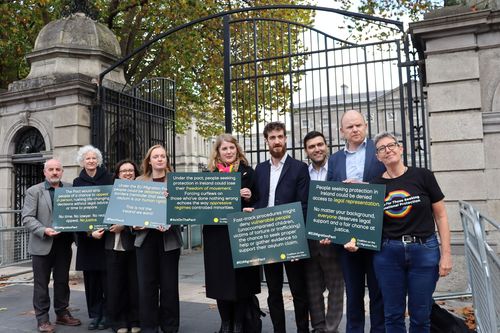
The Irish Refugee Council has coordinated a national civil society coalition that monitors, analyses, and seeks to influence how the Pact is implemented in Ireland. Please see the coalition's submissions
Who is impacted by the new Act?
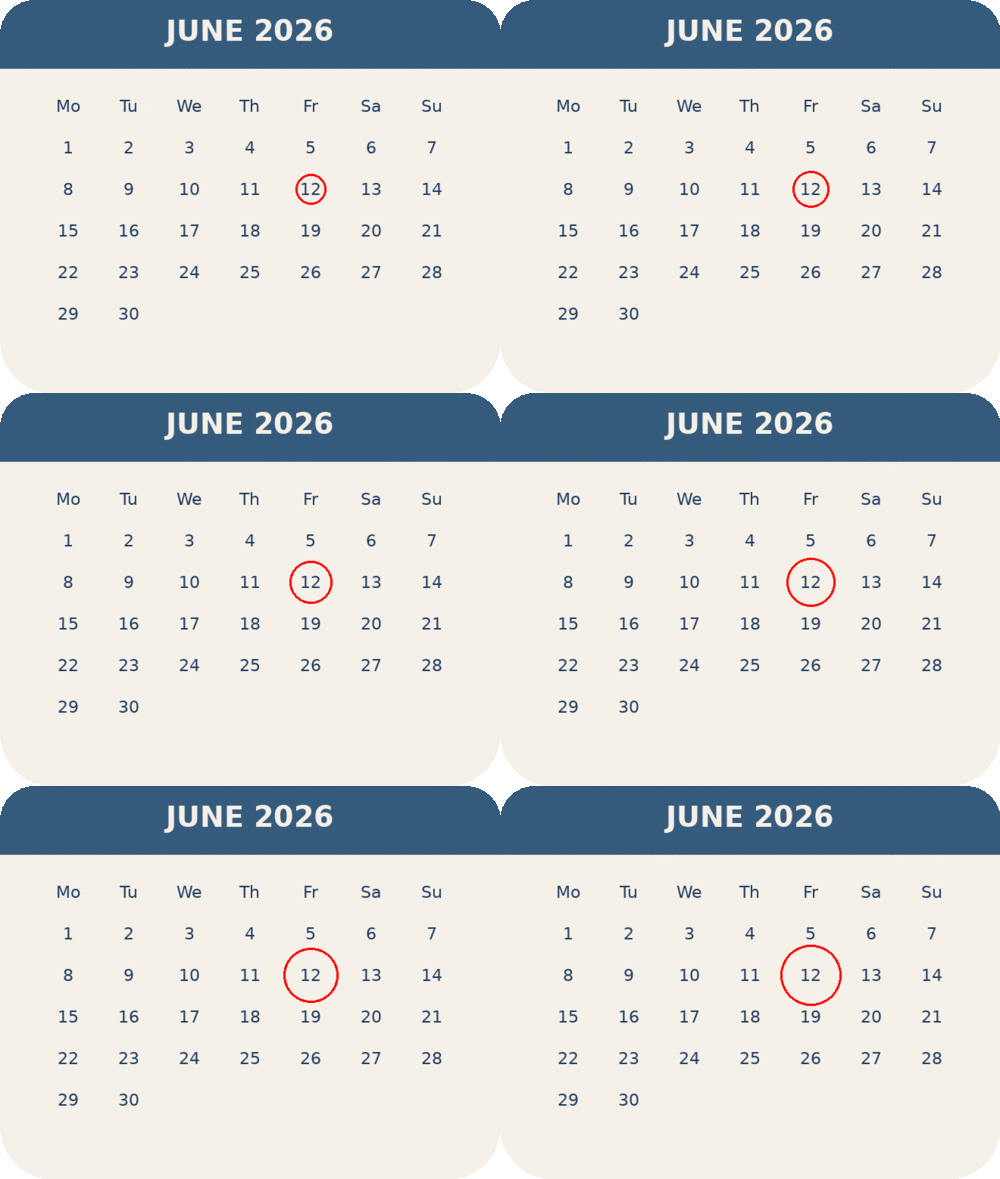
If you applied for asylum after June 12th 2026, your application will be processed under the new rules (International Protection Act 2026).
If you applied for asylum before this date, then your application is being processed under the old rules (the International Protection Act 2015).
In the other words, the new rules will mainly impact people who apply for asylum from June 12th onwards.
The extent to which the new rules will impact an asylum application will depend on many factors including how someone arrives to Ireland, their country of origin, vulnerability etc
Please note, there are some changes that impact everyone in the asylum process/living in IPAS accommodation, regardless of when they applied for asylum. For example family reunification and IPAS cost contributions.
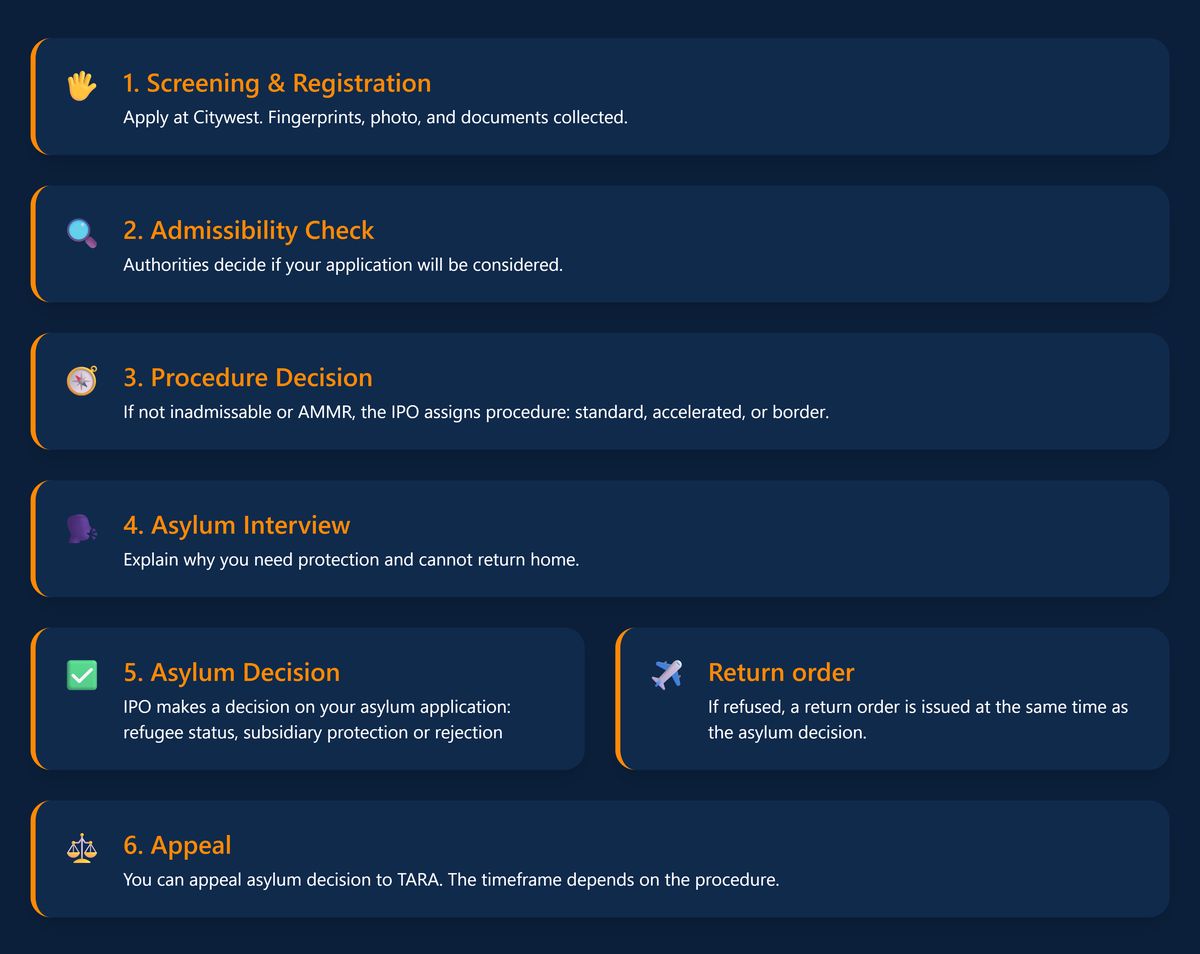
Overview of Steps
Screening
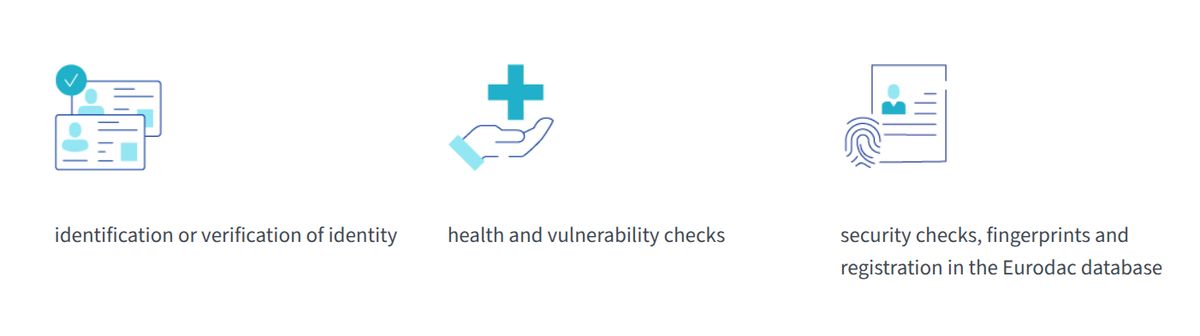
Under the 2026 Act, if you arrive to Ireland to claim asylum, you will undergo screening at a screening centre (generally Citywest Convention Centre).
The screening process should be finished within 7 days but it can take more in practice.
During screening you will be offered accommodation in or near the Citywest Convention centre. We understand most people in the screening process are accommodated in Cityark Hotel, Citywest. You will continue to reside there until the process is complete.
After screening you may be transferred to another accommodation centre within or outside of Dublin.
What happens during screening?
1 Fingerprinting and searches

Arrive at the Citywest Convention Centre
You will have your Fingerprints and photograph taken
Your phone will be checked - the contents found could be used against you in your asylum application
You will undergo a physical search
2 Information & guidance

You can attend the Legal Aid Board's legal counselling service.
The aim of this service is to help you understand the asylum process and how to complete your questionnaire
They will also help you to apply for a lawyer who will represent you in your asylum application
Hopefully you will you be allocated a lawyer quickly and can have a meeting with them before you submit your application form. The application form is a very important legal document
3 Registering your asylum application
During registration you will be asked questions about how you travelled to Ireland and what documents you used.
If relevant, you may be asked to explain why you came to Ireland "irregularly" (without a valid visa or permission)
4 Health and vulnerability check

You will be asked to undergo:
a health assessment by the HSE to identify any serious diseases or needs, and;
a Preliminary Vulnerability Assessment to identify if you have any special needs when it comes to your accommodation or if you need any special supports navigating the legal process of seeking asylum
5 Lodging your application
This involves completing and submitting your application form
During the screening process, you will be helped to set up an IPO Portal account. Your portal is extremely important and you should check it everyday if you are waiting for invitation for interview or a decision.
Supports and Services during screening
While you are in the Citywest Convention Centre undergoing screening, you will apply for a PPS number. A PPS number is a unique reference number that helps you access public services in Ireland.
Once you receive your PPS number (which should take a few days), you will also be able to apply for a social welfare payment called a daily expenses allowance. Please see more information on the payment here
Do I have to undergo screening if I had status in Ireland before applying for asylum?
If you have an existing immigration permission in Ireland (such as a Stamp 2 student permission), you are allowed to apply for asylum.
According to section 22 (4) (a) and 23 of the 2026 Act, you should not be required to undergo screening. If you are required to do so, the IPO need to explain why it is necessary to do so, in writing.
However, it appears that this is might not be happening in practice and applicants with pre-existing immigration permissions are undergoing the screening process.
What happens after screening?
An immigration officer will decide, based on the screening process, what happens next with your case.
At this point, it might be decided that a case is:
- inadmissible - this means the IPO does not want to give you access to the asylum process in Ireland. This could be, for example, because you have a protection status in another EU country or you are coming from a safe third country (e.g the UK).
- subject to The Asylum and Migration Management Regulation (AMMR) - this means that Ireland wants to send you back to another EU country for your asylum claim to be processed there.
More on inadmissability and AMMR here
Otherwise, the IPO will decide which procedure your case will be placed in.
There are 3 procedures: standard, border and accelerated.
The Different Procedures - 2026 Act
Which procedure you are placed in will significantly impact how your application is dealt with, especially when it comes to processing times and your freedom of movement.
The Standard Procedure
- If your case is not subject to the border or accelerated procedure, it will be placed in the standard procedure; or
- you may be referred to this procedure due to vulnerability identified during the screening process
- You should be appointed to an accommodation centre while your asylum application is being processed (you do not have to stay at screening centre)
- It should take 6 months to process your application (not including an appeal), however the time limit can be extended up to a maximum of 21 months in certain circumstances.
- You will have one month to appeal your international protection decision to TARA if necessary
- If you do not receive a decision within 6 months, you should be able to apply for work permit.
Border Procedure
- You may be required to stay at the border or Citywest reception centre while your asylum application is being processed, if you did not have permission to enter Ireland AND one of the following situations apply:
- you applied at a port or screening centre (“external border crossing point”)
- you were transferred back to Ireland under AMMR
- you were apprehended in connection with an unauthorised crossing of the external border
- Your case will be determined there, quickly = within 12 weeks from start to finish (this includes appeal)
- You will be asked to sign into your accommodation once in the morning and once in the evening
- You may also be placed in this procedure if you were transferred back to Ireland under AMMR.
- The border procedure can be mandatory if you are deemed to have intentionally misled the authorities, to be a danger to national security, destroyed a travel document (in bad faith), or if you come from a country with EU wide recognition rate lower than 20%
- You will have 10 days to appeal your international protection decision to TARA
Accelerated Procedure
- This procedure should be applied to applicants who are not subject to the border procedure but whose case is deemed inconsistent, false, improbable or misleading, after the screening process.
- It may also be applied if someone delayed making an application for asylum, is considered a national security threat, is making a 2nd application, is from a safe country of origin or from a country where the EU recognition rate is lower than 20%. In total there are 10 scenarios
- Your case should be determined quickly: it should take 3 months to process your application. Unlike the border procedure, this timeframe does not include the appeal.
- You should be appointed to an IPAS accommodation centre while you asylum application is being processed. You should not be required to stay at a screening centre or fulfil reporting requirements.
- You may be exempt from this procedure due to vulnerability or case complexity
- You will have 10 days to appeal your international protection decision to TARA
Return decisions

A return decision means the government decides that a person must leave Ireland, usually because an asylum application is rejected or withdrawn. The person might be sent back to their country of origin or to another country found to be responsible for them.
Return decisions will be issued much faster under the new Act, at the same time as the negative first instance decision.
You can appeal a return decision to the appeal Tribunal (TARA) however the appeal does not suspend the return decision.
In other words, it is possible that someone subject to a return decision could be removed from Ireland, before appeal getting a decision on their appeal.
If someone is removed from Ireland following a return decision, they are banned to re-enter.
If someone subject to a return decision, opts to return to their country voluntarily or leaves Ireland in compliance with the decision, the return decision and the re-entry ban may be revoked (cancelled).