Family Reunification (2026 Act)

The Irish Government introduced new rules on family reunification for refugees and subsidiary protection holders.
The new rules were introduced as part of the International Protection Act 2026, which started on June 12th 2026.
Any applications for family reunification which are triggered on or after June 12th will be assessed under the new rules.
If you applied for family reunification before June 12th, then your application should be processed under the "old rules" set out in the International Protection Act 2015. Please see here
Organisations supporting refugees and people seeking protection have strongly criticised these new rules, describing them as cruel and inhumane. Please read the full press release here.
Page Contents
This page discusses family reunification after June 12th 2026, it covers the following scenarios:
My family members are outside of Ireland
My family members are outside of Ireland
A refugee or beneficiary of subsidiary protection can apply for certain family members who are abroad under Section 205 of the 2026 Act.
The familial relationship must have existed before the sponsor arrived to Ireland.
When can I apply?
You must wait 2 years from the date of your grant of international protection (Ministerial Letter) before you can start the application for family reunification.
What are the financial requirements?
When assessing your application, the Minister will consider if you have “sufficient resources” to support yourself and your family members.
To determine this, the Minister will look at four things:
Income: Whether you are earning a "minimum level of income"
Social Welfare: Whether you are receiving certain social welfare payments, or have received them in the past 2 years. This could prohibit you from applying for family reunification
Housing support: Whether you are receiving certain housing supports from the State, or have received them in the past 2 years . This could prohibit someone from applying for FR.
Owing money to IPAS: Whether you owe money to IPAS for your accommodation/reception (12 weeks or more). In this case, you could enter into a repayment arrangement with the State and FR may be granted. For more information on this please read this page.
The Minister has discretion to waive the social welfare and housing support requirements where you received the supports for less than 6 months total in the proceeding 2 year period.
What family members can I apply for?
As an adult who has refugee status or subsidiary protection, you can apply for:
- a spouse or civil partner
- a de facto partner
- This would involve showing that you lived together with your partner in an "intimate and committed relationship" and that your relationship is stable and continuing. See the full criteria here
- a minor child
- an adult child but would have to show long term dependency or a disability
- a parent but would have to show long term dependency or a disability
My family members are already in Ireland
A refugee or beneficiary of subsidiary protection can apply for certain family members who are already in Ireland under Section 204 of the 2026 Act.
The family members must be in Ireland on the date of the FR application. They can be in Ireland “lawfully or unlawfully.”
This application must be made within 12 months of the grant of international protection.
In this section, the Minister “shall” grant FR where the Minister is satisfied that the person is a family member of the sponsor.
The Minister retains discretion to refuse an application “in the interest of national security or public policy.”
In this section, “family member” means:
What family members can I apply for?
As an adult who has refugee status or subsidiary protection, you can apply for:
- your spouse or civil partner
- Your minor or adult dependent children (they must be unmarried)
Applying for "new" family members - Join Family Visa
If a family relationship started after you came to Ireland, you cannot apply for them under the 2026 Act, however there may be another pathway you can investigate.
Non-EEA residents in Ireland can apply for family members to live with them in Ireland under the Non-EEA family reunification policy document (join family visas). This document was revised on the 12 June 2026.
Under the revised document, beneficiaries of refugee status and subsidiary protection can only apply for family members where the relationship began after the sponsor came to Ireland. However, the sponsor must wait 2 years from the date of receiving their status (Ministerial letter) before they can apply for a join family visa.
The sponsor must also "assume full financial responsibility for the family member they are seeking to bring to reside in Ireland with them."
How much money do I have to earn as a sponsor?
If you have refugee status or subsidiary protection, you are a Catagory C sponsor under the Policy Document.
The minimum income you would have to earn as the sponsor depends on who you want to apply for.
Applying for a spouse: If you are only applying for a spouse, you would have to be able to show that you earned more than €30,000 (before taxes are deducted) in the year before applying for the visa.
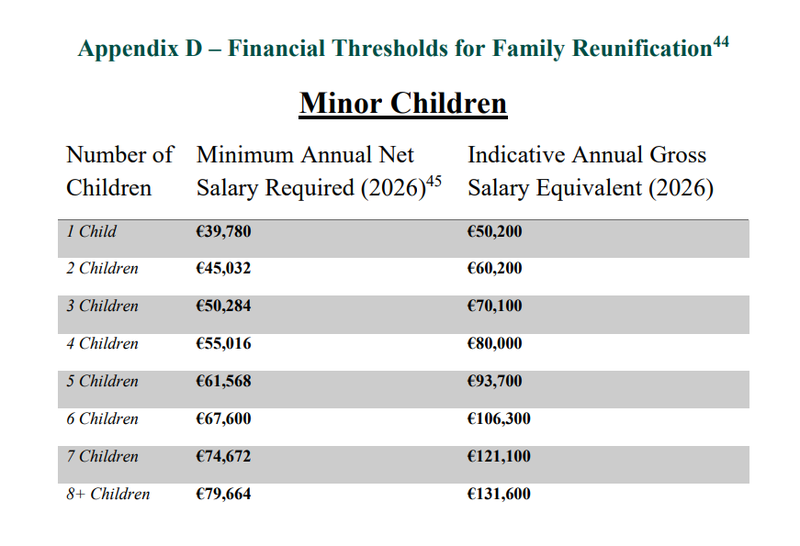
Applying for children: the minimum income changes depending on how many children you have. Please see the table below.
See Section 10 of the Policy Document for more information on income thresholds.
Can I apply if I received (am receiving) State supports?
Section 9.4 of the Policy Document says that you, the sponsor, must not be living homeless accommodation, IPAS accommodation, social housing or local authority housing.
It also says that if you are receiving HAP, you "may not meet the requirements of the Policy".
Section 9.3 says that you, the sponsor, would have to able to support and accommodate your family "without recourse to public funds". This means you would need to show that you have the ability to provide suitable accommodation for your family through a private rental or home ownership.
The Policy Document does not specify if a sponsor may not meet the requirements because they availed of State Supports in the past.