Final Negative Decision
The information on this page is for people who have received a final negative decision on their application for international protection.
To better understand the steps that lead up to the final decision, please read this page.
Permission to Remain Review
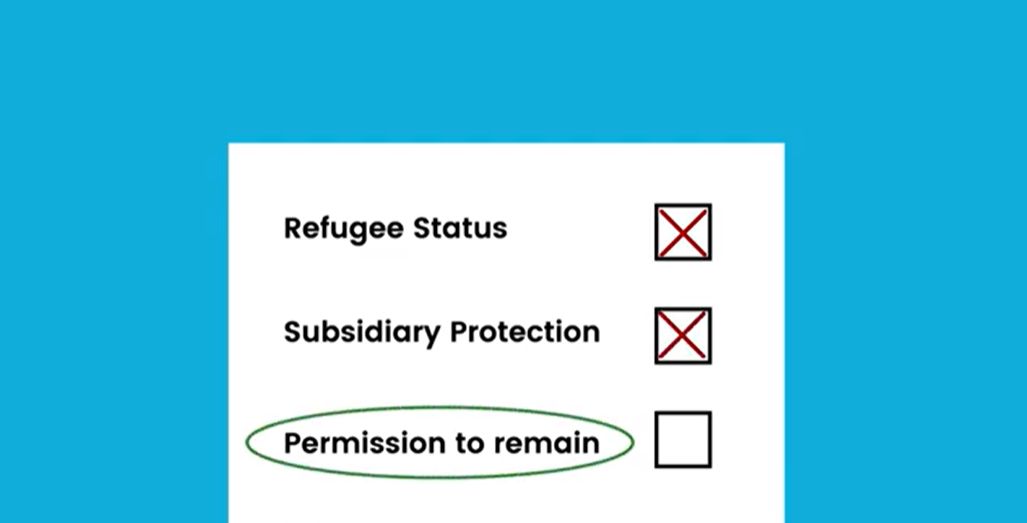
If your appeal to International Protection Appeals Tribunal (IPAT) is unsuccessful the Minister for Justice can review the IPO decision on permission to remain.
You have 5 days to send the Minister any new or important information relevant to this decision. This can include:
- new circumstances that happened after the first decision
- information that the Minister did not have before
You may wish to include information about your connections with Ireland, such as:
- family life
- employment / education
- personal or medical circumstances
- humanitarian reasons
You should keep your lawyer and the IPO / IPAT up-to-date on any information that could relevant to a permission to remain application, throughout the asylum process.
Voluntary Return
At any point in the protection process, a person may withdraw their application and return voluntarily to their country of origin.
The International Organization for Migration (IOM) can provide free advice and help with voluntary return.
This includes booking flights, providing travel documents, and support for reintegration.
If you have received a final negative decision, you can still apply for Assisted Voluntary Return, but you must inform the Minister in writing within 5 days of receiving the decision.
Choosing voluntary return allows you to avoid deportation and the associated lifetime re-entry ban
Judicial Review (High Court challenge)

A person may challenge an IPAT refusal of refugee status or subsidiary protection through Judicial Review (JR) if procedural mistakes were made during the IPAT decision process.
The High Court will look only at legal issues in the decision-making process.
It does not reconsider your personal story or facts of your case.
To bring a Judicial Review, you must contact a solicitor experienced in international protection law, who will assess whether there are good legal grounds for the case.
Judicial Review is not covered by legal aid. You must pay your own legal fees.
In international protection cases, you must first apply for leave (or permission) from the High Court to bring a Judicial Review.
- You must apply within 28 days of receiving the negative IPAT decision or Permission to Remain refusal.
- Your legal team will file detailed documents in the Central Office of the High Court
Deportation Order

A deportation order is a legal order from the Minister for Justice requiring a person who is not an Irish citizen to:
- leave Ireland within a specified time, and
- remain outside Ireland permanently.
If you receive a final negative decision on your international protection application you may be issued with a deportation order.
It is important to note that a deportation order includes a lifetime re-entry ban.
The deportation order will tell you the date by which you must leave Ireland.
If you do not leave by that date, you may face forced deportation.
The Garda National Immigration Bureau (GNIB) is responsible for organising and carrying out deportation orders.
Failure to comply with a deportation order can lead to arrest and detention without warrant under section 5(1) of the Immigration Act 1999.
Revoking a Deportation Order
A person who is the subject of a deportation order can ask for the deportation order to be amended or revoked.
You should speak to a private immigration lawyer for support in this.
Factors that the minister would consider include:
- your age
- time spent living in Ireland
- family and domestic situation
- connection with Ireland
- Employment history and employment prospects
- Character and conduct
- Humanitarian concerns
- Any representations made on your behalf
- The common good, and national security and public policy
Non Refoulement
A person cannot be returned to a country where:
- their life or freedom would be threatened because of their race, religion, nationality, political opinion, or membership of a particular social group, or
- they risk the death penalty, torture, or inhuman or degrading treatment or punishment.
Before issuing a deportation order, the Minister must consider whether any of these risks apply.
If your circumstances have changed in this regard, you should send the Minister any new relevant information.
The Minister will look at:
- any new information you provide
- all previous information in your protection application
- country of origin information
If the Minister decides there is no risk of refoulement, and no other reason to prevent deportation, you will receive a notice telling you when you must leave Ireland.
Subsequent Application (Section 22)
A person who previously applied for international protection and wants to make a new application for international protection must first apply, in writing, to the Minister for permission.
There is no interview.
The Minister must give consent if:
- new evidence or findings exist that make it significantly more likely that the person now qualifies for protection, and
- the person could not have presented this information during their previous application,
or
- the person’s previous application was withdrawn through no fault of their own.
If the Minister refuses consent, you can appeal to the IPAT within 10 working days.
The Tribunal will make a decision without an oral hearing.
A Section 22 application does not stop the possibility of deportation.
You may ask the State for an undertaking not to deport, but this is not guaranteed.
You should speak to a lawyer experienced in International Protection to assist you with this. The Legal Aid Board might be able to assist.